
USCIS Can Now Deny Incomplete Immigration Applications Without First Issuing an RFE or NOID
U.S. Citizenship and Immigration Services has announced an important policy change that could significantly affect people filing immigration applications and petitions.Effective Au...
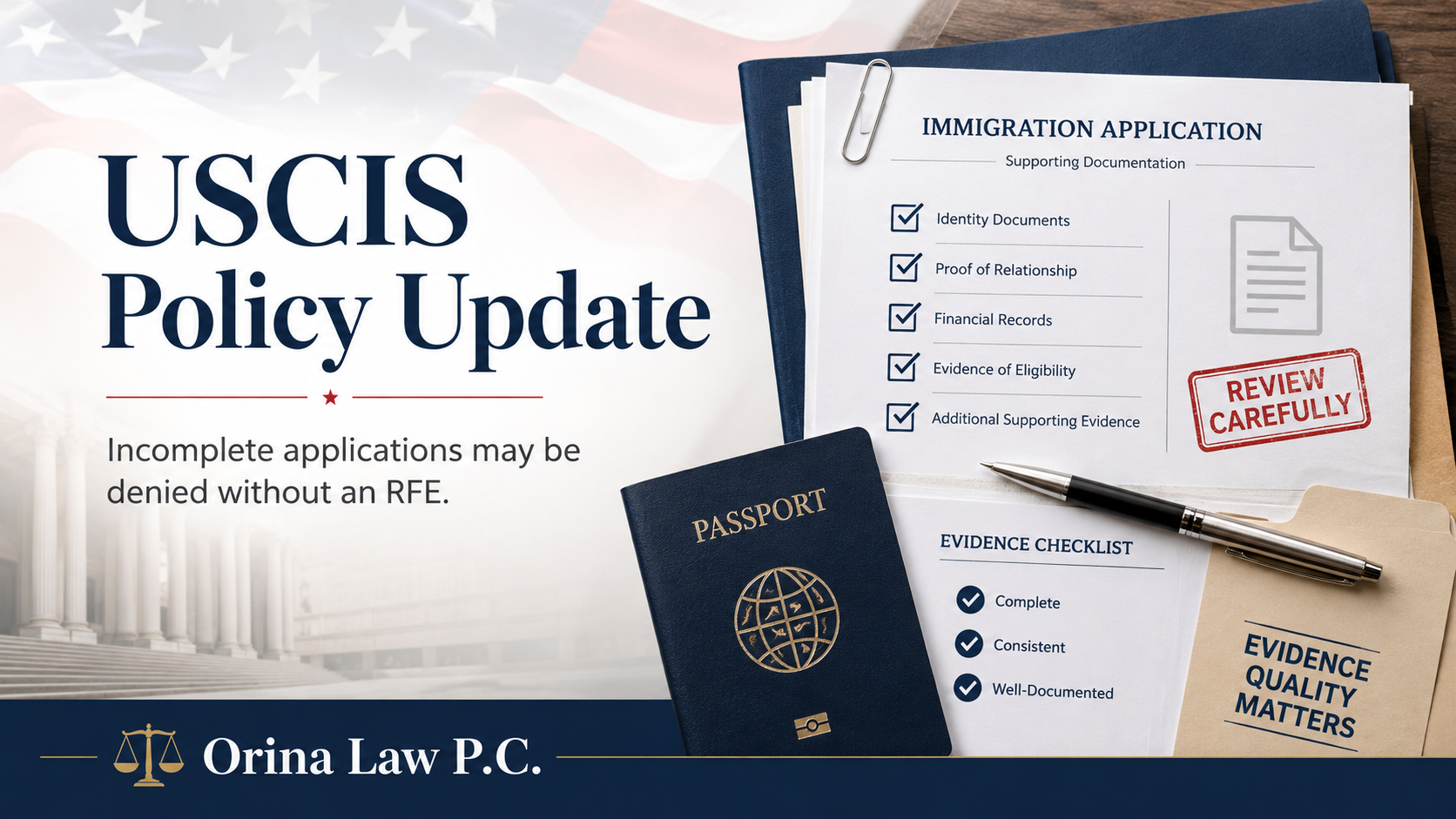
U.S. Citizenship and Immigration Services has announced an important policy change that could significantly affect people filing immigration applications and petitions.
Effective August 5, 2026, USCIS officers have greater discretion to deny certain immigration benefit requests without first issuing a Request for Evidence, commonly known as an RFE, or a Notice of Intent to Deny, commonly known as a NOID.
The policy applies both to new filings and to cases that were already pending with USCIS on August 5, 2026.
What Changed?
In the past, applicants and petitioners often expected USCIS to issue an RFE when supporting documents were missing or when the evidence submitted was not enough to establish eligibility.
That expectation is now risky.
Under the updated policy, USCIS may deny an application or petition without providing another opportunity to correct the filing when:
- Required initial evidence was not submitted;
- The filing is materially incomplete;
- The applicant or petitioner did not establish eligibility at the time of filing;
- The application or petition has no legal basis for approval; or
- The evidence submitted does not satisfy the applicable legal requirements.
USCIS may still issue an RFE or NOID, but applicants should not assume that the agency will give them an opportunity to supplement an incomplete case.
Why This Matters
The person requesting an immigration benefit has the burden of proving eligibility. That eligibility must generally exist when the case is filed and must continue throughout the adjudication process.
This means that filing quickly without the required supporting documents may create serious consequences. Depending on the case, a denial could result in:
- Loss of filing fees;
- Delays in obtaining lawful immigration status;
- Loss of a priority date or other filing-related benefit;
- The need to file a new application or petition;
- Expiration of work authorization or another temporary benefit;
- Complications in a pending adjustment-of-status or removal matter; or
- Increased legal costs.
An applicant should not rely on a future RFE as a strategy for completing the case later.
USCIS Is Targeting Placeholder and Incomplete Filings
USCIS explained that the prior policy could encourage frivolous, placeholder, or substantially incomplete filings. According to the agency, some applicants filed incomplete cases to obtain temporary or ancillary benefits while waiting to gather the required evidence.
The new policy restores officers’ discretion to deny cases that do not contain the required initial evidence.
The practical message is clear: an immigration filing should be complete and legally supportable when USCIS receives it.
RFE Response Deadlines May Be Shorter
The policy also changes how USCIS approaches deadlines for responding to RFEs and NOIDs.
An RFE response period may not exceed 12 weeks, but USCIS is not required to give applicants the full 12 weeks. A NOID response period may not exceed 30 days.
USCIS may therefore give a shorter response period depending on the circumstances of the case. Extensions generally are not available.
When a notice is served by mail, USCIS adds three days to the response deadline. USCIS will no longer provide the additional 14 days that were previously given for certain notices mailed outside the United States.
Applicants should carefully review the specific deadline printed on the notice and begin preparing the response immediately.
A Partial RFE Response May Lead to a Final Decision
The updated policy also states that when USCIS receives a response to an RFE or NOID, even if the response addresses only part of the agency’s request, USCIS may treat the submission as a request for a decision.
In other words, USCIS does not have to issue another RFE simply because the first response was incomplete.
Before submitting an RFE or NOID response, applicants should confirm that every issue raised by USCIS has been addressed and that all available supporting evidence has been included.
What Evidence Should Be Submitted?
The required evidence depends on the immigration benefit being requested. A complete filing may include:
- Properly completed and signed immigration forms;
- The correct government filing fee;
- Proof of lawful entry or immigration status;
- Birth and marriage certificates;
- Divorce decrees or death certificates from prior marriages;
- Financial sponsorship documents;
- Tax returns, transcripts, pay statements, and employment verification;
- Evidence of a bona fide marriage;
- Medical examination records;
- Certified English translations;
- Academic records and professional credentials;
- Employment letters and expert opinions;
- Evidence supporting humanitarian or hardship claims; and
- A legal explanation connecting the evidence to the applicable immigration requirements.
Submitting documents is not always enough. The evidence must be relevant, credible, properly organized, and sufficient to establish each required element of the immigration benefit.
What Should Applicants Do Before Filing?
Before sending an immigration application or petition to USCIS:
- Confirm that you are legally eligible for the benefit.
- Review the current edition of every required form.
- Review the applicable form instructions.
- Confirm the correct filing fee and filing location.
- Include all required initial evidence.
- Make sure every form is properly signed.
- Obtain certified English translations for foreign-language documents.
- Explain missing or unavailable documents.
- Review the entire filing for inconsistent names, dates, addresses, and immigration history.
- Keep a complete copy of everything submitted.
A small omission can become a major problem when USCIS is permitted to deny the case without first requesting additional evidence.
Does This Policy Apply to Every Immigration Case?
The policy broadly affects USCIS benefit requests, but some categories, including refugee and asylum applications, may be governed by different regulations and procedures concerning evidence, RFEs, NOIDs, denials, and failures to appear.
Every case should be evaluated based on the specific immigration benefit, the applicable regulations, and the individual’s immigration history.
How Orina Law P.C. Can Help
Immigration applications are not simply collections of forms. Each filing must establish eligibility under the applicable law and include the evidence necessary to satisfy the applicant’s burden of proof.
Orina Law P.C. assists individuals, families, professionals, employers, and other petitioners with preparing and reviewing immigration filings, including:
- Marriage-based green card applications;
- Family petitions;
- Adjustment of status;
- Consular processing;
- Employment-based immigration;
- National Interest Waiver petitions;
- Extraordinary ability petitions;
- Citizenship and naturalization;
- Removal defense;
- Humanitarian immigration matters;
- Responses to Requests for Evidence; and
- Responses to Notices of Intent to Deny.
Before filing an immigration application or responding to a USCIS notice, consider having the matter reviewed by an experienced immigration attorney.
To schedule a consultation with Orina Law P.C., visit www.orinalaw.com.
Final Takeaway
The August 5, 2026 policy change makes complete and careful preparation more important than ever.
Applicants should not assume that USCIS will issue an RFE or NOID before denying an incomplete or legally insufficient case. The strongest approach is to submit a complete, accurate, and well-supported filing from the beginning.
Disclaimer:
This article is provided for general informational and educational purposes only. It does not constitute legal advice and does not create an attorney-client relationship. Immigration law and agency policies may change, and the appropriate strategy depends on the facts of each case.
This article is provided for general informational and educational purposes only. It does not constitute legal advice and does not create an attorney-client relationship. Immigration law and agency policies may change, and the appropriate strategy depends on the facts of each case.
A suggested SEO title is “USCIS May Deny Incomplete Immigration Applications Without an RFE.” The meta description can read: “A new USCIS policy allows officers to deny certain incomplete immigration applications without first issuing an RFE or NOID. Learn how to protect your case.”